GETTING OLD SUCKS

Grant Evans in Alert Bay

Grant Evans in Alert Bay

Some mornings the only thing that gets me out of bed is having to go to the bathroom. The sameness of each day weighs down hard and I wonder “what’s the point?” On other days with the morning sun shining through the crystals in our bedroom window, I awake with purpose, with plans for the day, and I’m glad I’m alive.

Grant doesn’t seem to have his up and down mornings. When I say, “Morning, Grant, how are ‘we’ today?”

He invariably answers, “vertical!”

He stoically ploughs through life (often humming a tune), despite failing eyesight, near total deafness, a bad knee, three metal rods in his hip (he had a fall), vertigo and heart disease. As he says, “What do you expect at eighty-eight?”

I expect more. I had one grandmother who was elderly at age eighty-one and another one who lived happily alone in a walk up flat in Oak Bay. Until she broke her hip. Then broke the other one and died at age ninety-four.

I want to be that old lady, without the broken hip part. I am learning to carry a walking stick because I trip…a lot. I fall in the garden. I’m learning to look where my feet are going instead of barging through carelessly. I’m a slow learner.

A dear writer friend fell recently at home, alone. You can guess the rest. This bright, creative, active woman, apparently suffered a head injury, is now in a care home, no longer able to read or write.

Liz and Maureen and dog Blaze at the river 2022 Liz with a walking stick!


“GETTING OLD SUCKS!”

These are the words an old elementary and high school friend texted me after reading a recent blog of mine. His wife isn’t well; his life is turned upside down. I get it.  To be losing someone you love and being powerless to stop it, must be hell. For him old age does suck. I wish him and other close friends and family in a similar situation the strength and compassion to get through this stage of their life.

But many older people toss those words around when really if they accept that they are in the third stage of their lives, elderhood, that they have it pretty good.

Granted for many people getting old isn’t kind. Things don’t work the same, bodies creak, breath is short, energy is compromised, I can attest to all the above. As educated, middle class, pre-war and post war boomers, as most of my friends are, we are generally financially stable, have raised our children, if lucky retired with pensions and own our own homes. And we hopefully are at peace with our choices, accept and even love ourselves, viewing each day as a gift.

That statement may sound presumptuous. How dare she? Who does she think she is? Of course. We are entitled to our own opinions, and we have no idea what other people are going through. I am exploring one path of gratefulness.

There was a time when a close friend and I realized we were both two paychecks short of being homeless. We joked about being bag ladies. We were young and had no concept of what homelessness meant, as it does in our current society. I don’t take my comfortable life for granted; I keep a gratitude diary. If that sounds overly precious, so be it. I came through the Human Potential Movement of the 1960’s.

My word for the year (it’s a thing), is ACCEPTANCE.


Grant dug out his well-read copy of Joseph Campbell’s, The Power of Myth and pointed me to his (Grant’s), favourite reference to ‘aging like an old car.’

quote:

“The problem in middle life, when the body has reached its climax of power and begins to decline, is to identify yourself, not with the body, which is falling away, but with the consciousness of which it is a vehicle. This is something I learned from myths. What am I? Am I the bulb that carries the light? Or am I the light of which the bulb is a vehicle?”

***

“One of the psychological problems in growing old is the fear of death. People resist the door of death. But this body is a vehicle of consciousness, and if you can identify with the consciousness, you can watch this body go like an old car. There goes the fender, there goes the tire, one thing after another— but it’s predictable. And then, gradually, the whole thing drops off, and consciousness, rejoins consciousness. It is no longer in this particular environment.”

~Joseph Campbell

From The Power of Myth

I’m not sure if those old car images work for me. I think I’ll stick with acceptance and squeeze the most out of life, while I still can. And yes old age does and can suck.


If you enjoyed this and are curious about more content from an Island Crone, please subscribe from my web page/blog sidebar. I promise to post at least once a month and sometimes more. But not often enough to bore.

~ Island Crone by Liz Maxwell Forbes

www.osbornebaybooks.com


Facebooktwittermail

THE LIST

I am a compulsive list writer. It’s in my blood. It all started when we lived on Victoria Avenue in Oak Bay. On Saturday morning breakfast would be on the table, my Peter Rabbit egg cup holding my soft-boiled egg, toast fingers surrounding the egg cup and along side my plate, The List. The list of Saturday morning chores, one for me, one for my stepfather both written in my mother’s flowing and unreadable hand. (For some reason my little sister didn’t get one. Although she may have as she grew older.)

And so, when I grew up and had three children of my own and was working, I would leave them with their Saturday morning list. Unlike my mother, I never had the temerity to leave one for my husband. My writing was even more indecipherable than my mother’s which gave my children an easy excuse for not doing the chores. Although my younger son, who makes his living deciphering archival information, credits me for honing his ability to read poorly written script.

And I still write lists. Lists for myself. I start the morning with a list of what I hope to achieve that day. I have lists for household chores, phone calls to be made, writing to be done, things to buy and I highlight some with pink or yellow highlighters, depending on my current colour choice and I dutifully tick each one off as they are completed. I carry some through to the next day if they’re not done. This keeps me organized and accountable and offers a boost of satisfaction as I tick each one off. It’s like getting clicks of like or love on Facebook posts, feeding ones self worth. It also creates a certain amount of anxiety and self judgement when the tasks are not ticked off. This feeling of failure blossomed recently when other life events were sucking up my energy, and I couldn’t live up to my ideal self.

a rainy day outing

Then this happened.

I stopped making lists and suddenly I was free! I was free to do whatever I wanted with no judgement. If the sun was shining and Grant and I felt like going for drive, or to the ocean or out for lunch, we would go. I had nothing on my agenda holding me back. And if I felt like cozying up on the sofa with the fire going and nestling down with a book, I did that without feeling guilty. I even did a little gardening on the sunny days because I wanted to get my hands in the earth. I did whatever I wanted to do, binge-watched Shetland and other British series and enjoyed every minute. Pure self indulgence. This is how I expected retirement to be.

Ah but La-La land doesn’t last forever. It was a great sabbatical, but reality slithered in. I have a third memoir to finish, the one that’s sometimes called And the Dog Came Too and sometimes Under a Salish Moon. You know the one. I’ve been banging on about it forever. I’m embarrassed about how long I am taking. However, I just finished reading a recently published memoir by a ninety-eight-year-old woman; it took her twelve years to finish it. And she’s working on another. I have hope.

And I am back to writing lists. Wish me luck.

If you enjoyed this and are curious about more content from an Island Crone, please subscribe from my web page/blog sidebar. I promise to post at least once a month and sometimes more. But not often enough to bore.

~ Island Crone by Liz Maxwell Forbes

Facebooktwittermail

WOMEN GONE ROGUE

WOMEN GONE ROGUE

Has anyone else noticed the proliferation of older women on Facebook these days? Older women posting videos of their lives? Or are these just my algorithms? I follow a couple of these elder video blogs (or vlogs) and I think how brave, how entertaining but why? Is it for fun, or showing off, or because they can?

We are healthier and living longer, however many of us complain about feeling invisible, not taken seriously. Perhaps this is what’s motivating this emergence of videos portraying older women with their ‘look at me I still have it’ costumes. These outrageous women adorn their often-wrinkled bodies with heavy jewellery, scarfs, furs and lace as they girlishly prance in their stilettos. They’re not going to be invisible!

The vlogs I enjoy are of (not so ordinary) ordinary women. Women I would like to know, such as Barbara Shaw (Art in Textiles) from somewhere in Herefordshire UK as she shows off her clothing choice for the day, dons the wool sweater that she just finished knitting, tops it with a jacket she repurposed from an old blanket and then pulls on a hat and her matching gloves, comments on the weather and then with a twirl goes out into the British countryside for a walk. I love her, I am entranced, she does art as well, paintings and fabric art and her sweet smile makes me happy. Somebody films her obviously, but what is the purpose? Sharing her life with the world? Does she sell her knitting and paintings? Why has she chosen to do this?

Would anyone care if I had Grant video me as I got dressed? Done in good taste, of course. Let me see, what is my look for today…ah French Dressing jeans will do, with the butterfly patterned sox my daughter bought me last birthday, then picking up the mauve hues of the sox, I’ll pull on a purple fair traded ethically sourced organic cotton top and off I’ll go with a little twirl and girlish toss of my head to sit at my computer and write. Ah, maybe not.

There must be money in it. Somewhere. But how? Or am I missing the sheer creativity of it, a new art form?

Another video I watch is Bealtaine Cottage, in Ireland. Colette O’Neill is the creator. She has transformed her barren 3 acres of land and created a lush habitat, her videos follow the progress of her gardens, others show how she has artfully transformed her home. This charming Celtic mystic is also a Druidess, a writer, and a successful middle-aged woman living her dream life. A woman who has chosen to wear what ever she likes, mixing vintage and new and relishing in it.

I recently ordered Collette’s e-book Imbolc. Imbolc is a sacred festival celebrating the beginning of Spring and the Goddess Brigid in the Celtic calendar. Also called Saint Brigid’s Day. I have a cross of St Brigid, made of rushes hanging over my front door, brought to me by Grant’s granddaughter Sheena on her return from Ireland many years ago. I also wear a cross of St Brigid, a gift from Grant.

Imbolc falls on February 1st this year and we’ll be welcoming the subtle beginnings of Spring.

Sharon in her faux fur coat, never invisible

There are many middle-aged women out there in internet land, sharing their expertise, talents, creativity, some making a living out of it, others marketing their brand. The one thing they have in common apart from obviously enjoying themselves, is that they are not invisible! Take my dear friend Sharon pictured here in her faux fur coat, talking as always to a random stranger in a café. She’s dressed modestly on this day. Usually, she’s adorned with beads and scarves and layers and its always an adventure hanging out with her. She’s never invisible.

If you want to see other middle- aged women refusing to be invisible, you must watch Sally Wainwright’s new series, Riot Women on BritBox. (Sally Wainwright who gave us Last Tango in Halifax, Happy Valley and more.)  The acting is superb, the story line is poignant, tissue on hand recommended and it’s wildly funny, truly middle- aged women gone rogue.

So, my lovely women friends, wear what you like, laugh and celebrate friendships and don’t let yourselves slide into beige invisibility. Go a little rogue!


When I told Grant what I was writing about this month, he said. “What about old men? We become invisible too as we age.”

“Fair point,” I said. “Next month’s blog.”

From your Island Crone.

Facebooktwittermail

FIRST FOOT

HAPPY NEW YEAR

FIRST FOOT

I had dark hair when I was young and was often asked by my grandparents to be the first foot. My grandparents on my mother’s side hailed from the old country, Scotland and Ireland bringing along their superstitions and ancient Gaelic traditions. One of these being that the first person to cross your threshold on New Years Day had to be a tall dark-haired man. This man came bearing a lump of coal (for warmth), salt (for prosperity), shortbread (for hospitality) and a dram of scotch (for celebration). Guaranteed to bring you good luck all year. Fair-haired men or red-haired men brought bad luck, even death, possibly a throw back to the days of Viking Invaders. And for a woman to be first foot, it simply wasn’t done.

But here on the west coast of Canada the rules were more relaxed, superstitions were watered down and, in the event, there was no dark-haired man available on New Years Day, a dark- haired girl would do. At around age ten I was appointed first foot.

We heated our house with coal, so I carefully selected a lump of coal from our coal bin and a potato from the storage and walked over to my grandparent’s house on New Years Day. I was fussed over and fed tea and scones. Of course, I couldn’t first foot our house because I lived there, but sometimes my step- father circumnavigated that rule by leaving the house by the back door before midnight and returning to the front door to be let in after twelve midnight. He was British but just as superstitious about the New Years tradition of first foot. That tradition was so ingrained that my parents refused to open the door on New Years Day to any fair-haired person until a dark-haired had entered first.

Most people understood.

A few years later when I married my first husband a blue-eyed blond Viking, his mother a staunch Scot welcomed dark haired me, and I became her first foot on New Years Day. Even later our dark- haired youngest son became the designated bringer of good luck.

We’re all white haired now and I’ve let the traditions fade but not forgotten. Some years I would let carrying my black cocker spaniel out the back door and then letting him in the front door count as first foot. Sometimes I would lure an unsuspecting dark-haired person in on New Years morning, but it didn’t always work out well.

The last time I tried that was with the black-haired young wife of the couple next door. I went over early on New Years Eve and asked her to knock on my front door in the morning and bring a goodie, anything, piece of shortbread, kindling for the fire. Jokingly I suggested coal. I explained the tradition. A couple of times. Reassuring her.

Next morning I heard a timid knock on the door.

“Is this okay?” she said as she handed me a rock painted black. “Its not coal but the kids and I painted it to look like coal.”

“Perfect,” I said. “Come on in.”

She stepped cautiously into the hall eyes darting around anxiously.

“Here.” I said as I handed her a bag of chocolate treats. “This is for you. Happy New Year. You and your dark hair have brought good luck for the year. Thank you.”

“That’s it?” She gave me a searching look. “Weird.” I could hear her thinking. She almost ran down our driveway as she left.

my dark haired man

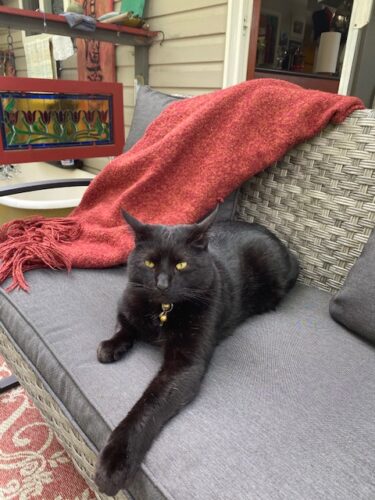
I let the ritual lapse after that. I did try to have a dark-haired person in first if I had a choice. However, my black cat Conrad has adequately filled the requirement, he’s a black-haired male. I just need to perfect the timing of his going and coming back in.

Much better than having the neighbours think I’ve gone doolally.

Let me know if you plan to practice New Years rituals or traditions this year. How do you mark the transition into a new year?

Whatever way you do it, I wish you a Happy 2026, with more love and caring in our world and enough food and warm shelter for all.

We haven’t even talked about our New Years resolutions! I make them every year…the same ones…LOL!

Blessings from your Island Crone

If you enjoyed this and are curious about more content from an Island Crone, please subscribe from my web page/blog sidebar. I promise to post at least once a month and sometimes more. But not often enough to bore.

~ Island Crone by Liz Maxwell Forbes

Facebooktwittermail

Bed Time Stories

Bed Time Stories

I am reading to my husband. At night. In bed.

Before he developed wet macular degeneration in both eyes, one of Grant’s greatest pleasures was going to bed with a book, reading until he fell asleep. We both read at night, and as we had no television or electronic devices in the bedroom he was adrift.

childhood reading

Then I remembered how wonderful it was to be read to when I was a child and I offered to read to him. I had forgotten that Grant’s taste in books leaned more to the philosophical, or cerebral than mine. My perfect bedtime reading is something like The Thursday Murder Club, good old British whodunits. Like me Grant has a whole wall of books in his study, including ‘books to be read’, plenty to chose from for bedtime reading, however there was a new Ian McEwan book out, one he didn’t have, so off we went to our local indie bookstore, Volume One Books and bought a hard cover copy of What We Can Know.

Once we got into the book it was gripping, exploring a dystopian future, flipping back and forth between 2015 and 2119 where scholars felt nostalgic for our current times. The plot twists with a couple of love stories and a mystery, and the effects of nuclear war kept me awake at night.

Not good bedtime reading. Although I would read it again. In fact we almost began again from the beginning.

However Grant had more books queued up…

The next book Grant tossed on the bed for me to read was a battered pocketbook, Hermann Hesse’s Gertrude, first published in 1910.

I groaned. I’ll never be able to read that tiny print with my eighty-six-year-old eyes.

(BTW. Did you know I am the same age as Margaret Atwood? Just saying.)

Surprisingly the print in this old pocketbook with the ancient, yellowed paper

was quite readable even with only my drugstore glasses. And the story was strangely compelling. It seems we are on a Hesse immersion course, or a ‘Hessepalooza’, carrying on with Under the Wheel, another coming of age story with Hesse, and now tonight, before we go on to Siddhartha and Steppenwolf we will conquer The Journey to the East. In between Hesse we dipped into David Brooks, The Second Mountain. I found his sentences more convoluted than Hesse’s, and harder to read.

It was being read to as a child that motivated me to learn to read. My best friend Roger and I attended kindergarten together and his mother took care of me after school. Every afternoon we would sit in front of the fire (no central heating), and his mother would read to us. At first it was Beatrix Potter, moving on to A.A. Milne but then his mother began reading the Arthur Ransom books and we were hooked. They are wonderful British stories about a group of children who went on great sea faring adventures without adults, books with titles like Swallows and Amazons and We Didn’t Mean to Go to Sea”.

A.A. Milne

The thing was, Roger was beginning to read the Arthur Ransome books on his own and we were the same age. I was competitive and needed to keep up with him. So somehow by age five I also learned how to read. And of course, I read to my children when they were young.

But this hour of reading to Grant every night is different, more meaningful. We enjoy dissecting the story line after, sharing our pleasure with the writing. Or not.

And I am enjoying this reading practice, it’s calming and grounding, a good prelude to sleep.

Grant says he feels nourished.

What could be better than that?

If you enjoyed this and are curious about more content from an Island Crone, please subscribe from my web page/blog sidebar. I promise to post at least once a month and sometimes more. But not often enough to bore.

~ Island Crone by Liz Maxwell Forbes

Facebooktwittermail

THE THINGS THAT GIVE ME JOY

Something wonderful happened this October month. Something that helped me soar over everything else that was going on.

We were enjoying a family birthday lunch for my daughter Maureen at the Cowichan Bay Pub when a woman whom my eldest son knew came to our table. She was one of those slender fit beautiful silver-haired women in her 80’s and she wanted to tell me how important my memoir Growing Up Weird was for her.

“We’ve all had those experiences,” she said, “I’ve lent it to a friend. I am so glad to have met you.”

And then a few days later, my son Mickey, same son, was chatting to another Cowichan Bay resident, again a professional woman close to my age who thanked him for giving her a copy of my book. She hinted at growing up with a similar background and had lent it to a friend who also resonated with the story.

There’s magic in the number three and October ended with a text from my sister Kate, “I was at a friend’s 80th birthday party yesterday and her three sisters were all raving about your book.” They had also grown up in Oak Bay.

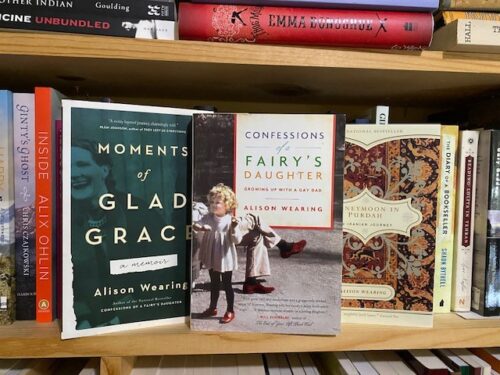
The book Kate was referring to is my memoir of Oak Bay in the 1940’s and 1950’s. It wasn’t meant to be published, after all it held family secrets and uncomfortable subjects. It grew from a writing prompt twenty something years ago with my Chemainus Writers group. Once I started writing (there were harsh memories, sexual abuse, and normal growing up adventures), I became immersed in the past, and I often wrote in a child voice. It was cathartic and healing.

my mother, step-father, sister, baby brother and me

At that point I still viewed it as a record for my family and for my two siblings who were six and sixteen years younger and grew up with a different father and had different experiences. However, with encouragement from my writers’ group and my family I published Growing Up WeirdA memoir of an Oak Bay childhood.

I hoped by writing this book, it would not only give a snapshot of Oak Bay in the 1940’s and 50’s it would serve as an honest depiction about the difficulties many girls faced including the sexual abuse that we didn’t talk about. I hoped my story would help someone else. Help them to know they weren’t at fault, and they weren’t the only one.

And the ‘everything else’ that’s going on that I mentioned in the beginning?

Apart from climate change, the unhoused, the world in general, I am having health problems that have temporarily slowed me down but haven’t stopped me from writing.

To hear that my writing makes a difference is all I need.

And that’s what’s given me joy this October month.

If you enjoyed this and are curious about more content from an Island Crone, please subscribe from my web page/blog sidebar. I promise to post at least once a month and sometimes more. But not often enough to bore.

~ Island Crone by Liz Maxwell Forbes

Facebooktwittermail

THE ART OF THE JOURNAL

two favourite journals

I journal. I have a basket full of journals. Some are embarrassingly needy, fuel for a bonfire. My partner’s daughter Cheri burned her journals last spring. I thought that was a terrible loss but after perusing my older writings, I realized fire would be their best ending.

Some journals are worth keeping such as the small diary with a brocade cover, a gift from my sister Kate in 1981. I used this as a travel journal for twenty-five years.

There are a few common threads in it, New Years’ resolutions, the usual stuff, however the rest of the diary is filled with stories of my solo trip to the UK in 1984. Vivid descriptions of walking tours in London, or visiting the Bronte house in Haworth, Yorkshire, travelling the rails on the Flying Scotsman, motorcycling on the Isle of Skye and having my passport and traveller’s cheques stolen in Paris.

Pages are filled with trips to San Francisco, where my eldest son lived, hanging out in Haight-Ashbury, exploring the Mission district, sipping coffee on the street in Noe Valley, hiking up the city’s many stairs and hidden pathways, visiting City Lights Bookstore and climbing up to the Coit Tower.

All these rich memories are nestled in my diary, ready to be used in a story or just enjoyed straight up.

basket of journals

I kept on journaling, recording most of the trips that Grant and I took, but in an assortment of books, often changing mid trip because I found a nicer journal, a more interesting colour, one that brought me more inspiration.  These are the journals I used to write my latest book, my third book, the one that is still in the creating stage, now called Under a Salish Moon: Camping on the Coast.

I recently sent my ’finished’ manuscript to Michelle Barker, an editor with The Darling Axe editor group for a narrative assessment. In her detailed and extremely helpful, twelve-page assessment, she made positive comments:

“You add lots of local color with some good description.”

“You have a good ear for conversation and you’re able to catch people’s voices.”

“It was a pleasure to read this book. Your writing is vivid and made me wistful for the places you described…”

But.

There’s always a ‘but’.

There was this.

“The narrative often strays into feeling more like a journal (where you ate, who you saw, what you did).”

Well duh!

Clearly there’s a downside of relying on journals to add spice to my stories.

leather journal from Sheila, too nice to use

Never mind, I love writing and will be happily tweaking my Under a Salish Moon travel chronicles this winter. Spring release?

If you enjoyed this and are curious about more content from an Island Crone, please subscribe from my web page/blog sidebar. I promise to post at least once a month and sometimes more. But not often enough to bore.

~ Island Crone by Liz Maxwell Forbes

Facebooktwittermail
The sea walk gazebo in

CHANCE ENCOUNTERS IN THE GROCERY STORE

Picket fence

Chance encounters in the grocery store

I was doing a final round of the fruit aisle on my weekly grocery shopping trip when I ran into someone I hadn’t seen since last spring’s flu shot.

“Pam!” I said in surprise.

“Liz!” She replied.

We stood there and grinned at each other the way you do when it’s someone you like but you don’t know all that well.

“I’m enjoying your blog,” she said.

“Ah, thank you, I was thinking of skipping it this month. I haven’t missed one yet but…”

“No, you can’t!”  she interjected. “I look forward to it. It’s the highlight of my month.”

“Even when I write about uncomfortable things?”

“Especially those things,” she replied laughing.

My step was lighter as I walked away. I love getting positive feedback, it inspires me to keep on writing. I am writing the kind of content that I want to read and as Pam is around my age, she is whom I write for.

I had planned on letting the blog go this month. I am immersed in revising and polishing my up coming book to send to my editor for a narrative review and the work has consumed all my creative energies. The book is important, but this blog is so much fun to write, I know I can squeeze out a little more!

So, Pam, this ones for you.

Have you ever thought how grocery shopping is like the long-ago days when the women gathered at the communal well? It was usually the women who walked with their children to the well and washed the clothes and talked and gossiped and kept that thread of community happening and knew who was okay and who wasn’t.

If that’s a stretch, think about the weekly village market, the social day of the week where women put on their best clothes, mingled with their friends and neighbours, bought vegetables and goods for their families and caught up on the latest town news.

I know, men shop too, of course they do, and our society is different than the old village days, but we are more the same than you think. When I shop, once a week, I dress a little better, still casual wear, and I always run into someone I know and have an uplifting conversation. Often it is someone whom I haven’t seen in ages, such as my old friend Connie, and we do the Liz? Connie? dance. At first not sure, and then the years fall away and we have a heart warming catch-up.

As it happened, I ran into Connie the same day I ran into you Pam and it hit me… we underestimate the value of a grocery store. Not only does the store, in this case, our local Country Grocer, provide groceries, it also offers community, a feeling of belonging and of being known. It almost raises grocery shopping to a spiritual level, where our senses are stimulated by perfect piles of shiny red apples and we marvel at the bounty of food. We are all on a even playing field as we push our carts around piles of stock waiting to be shelved as we mumble at the rising costs.

The warm glow I feel after re connecting with friends, old and new softens the blow of the checkout total. My wish is that we all extend that warm feeling to the hard-working people in the store. A smile goes a long way.

Thank you, Pam for the inspiration!

Just so you know, this is a No Frills post as I am writing at the blog post deadline, due to my previously mentioned book manuscript that is awaiting in the wings. No Frills meaning I have no relevant photos to grace the blog. But you can visualize women blocking the aisles as they talk, and talk. Don’t you just love us?

love from your Island Crone.

If you enjoyed this and are curious about more content from an Island Crone, please subscribe from my web page/blog sidebar. I promise to post at least once a month and sometimes more. But not often enough to bore.

~ Island Crone by Liz Maxwell Forbes

Facebooktwittermail

PAINTING OR WRITING? EARLY MORNING MUSINGS

If you enjoyed this and are curious about more content from an Island Crone, please subscribe from my web page/blog sidebar. I promise to post at least once a month and sometimes more. But not often enough to bore.

~ Island Crone by Liz Maxwell Forbes

The Jazz Players

I know an artist who regrets each piece of art he sells. Years ago, when he belonged to a Chemainus Artist Group and was displaying his work, he sold his ‘Jazz Players’ to a woman from Calgary. Letting that painting go, was painful. He painted another, slightly different and it still hangs in our living room.

Yes. The artist is my partner, Grant.

Then there was the painting of the well loved Chemainus hermit, Charlie Abbott, shown walking along the railway tracks with the iconic Chemainus theatre in the background. Sold also to a woman from Alberta. Also greatly missed.

And his Arizona paintings, thirty- five small studies in oil of the churches, shrines and ancient symbols of the desert done over a winter in Arizona. We had an art show at the old Hummingbird Café in Chemainus when we returned, slapped a high price on them to discourage sales, which didn’t work, as he bid a sad farewell to some of his favourites, including his “Hoochie Coochie Girls.” He still talks about that one.

I know how that feels as I once wanted to be an artist. I studied at the local college, painted in oil because I loved the smell and painted trees, because I loved trees. There was one painting, a big one, of my eight-year-old stepdaughter Sue, sitting against the trunk of an old fir on the bank of the river. I captured her perfectly and had thought of giving it to her.

But an acquaintance saw the painting and wanted to buy it. I was flattered. However, she had no money and offered to do a trade, a hand-woven shawl from Guatemala in exchange for my painting. I reluctantly agreed.

A couple of years later, she asked for her shawl back in return for the painting. I said no. I was annoyed that she didn’t value my painting more than her shawl. I was annoyed that I let myself be manipulated and I’ve regretted that decision ever since for shortly after, the woman’s house burned down with my painting inside. (She had already moved out, as the house was condemned.)

I still have the shawl, but I never wear it.

There’s a moral here, but I have no idea what it is.

All I know, is that painting and writing are creative art forms, both arising from somewhere deep within.  I have lost myself in both pursuits, reaching that altered state where time has no meaning and the art is flowing, an artist high if there is such a thing. It’s a wonderful state of being.

However, I find writing to be simpler than painting. I can print copies of my writing on a sheet of paper or as a book and still have my original. And delete is quicker than painting over. (Painters can print giclees but it’s more involved.)

The difference between painting and writing for me as a memoir writer, is that once my writing is finished, it no longer belongs to me, it belongs to the reader who hears my words filtered through their own experiences. Even I, upon reading one of my books years after I write them, am not the same person; I have separated myself from the stories. I hear them differently; they are no longer mine.

Paintings, although infused with the artists emotions, feel more static. They capture a memory that is frozen in time and place. Maybe that is why many artists have difficulty selling their work. They’ll never be that person in that time again.

Writing and painting, both laying bare our innermost feelings, capturing fleeting moments, are we doing it for ourselves or for an audience?

And does it really matter?

In the end are these just idle early morning musings because my cat’s insisting that I wake up and I’m pretending I ‘m still asleep?

Facebooktwittermail

The Things We Leave Out
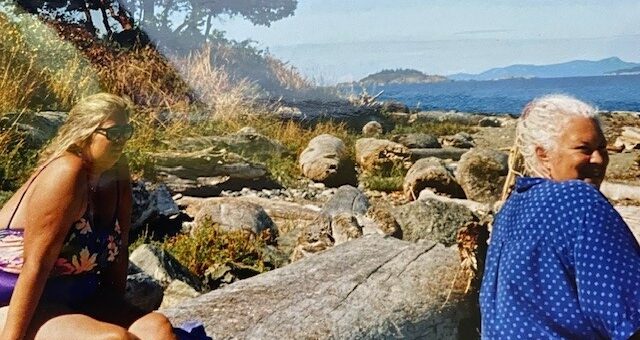
Maureen, Liz, Lantzville Beach

The hardest thing about editing is knowing what has to be left out/slashed/deleted. If it doesn’t belong, or move the story forward, it has to go. This story is one I had to drop as it isn’t about travelling on the coast. Yes it is on the coast of Vancouver Island, Lantzville to be precise, and it does include a dog, but it does not belong in my upcoming book. It is a story I love, a casual meeting on a summer day at the beach and I want to share it with you. It took place on a day in June 1995, thirty years ago.

I meet Violet Margaret Norback: 

On one of those days swimming in the waters off Lantzville and throwing sticks for Bodhi, with Grant lounging on the beach with a book, I noticed an elderly woman sitting on a weathered log. She watched as I emerged from the sea and shook the salt water from my hair. I threw another stick in the ocean for Bodhi and walked across the sand to where the old woman was sitting.

“Lovely day for the beach,” I called with a smile.

She didn’t respond and I was taken aback by her closed expression as she pushed away the thick white hair that hung over her forehead. Her pale cloudy blue eyes considered me for a long moment, then she patted the log beside her and said, “Come, sit with me. Don’t be shy.”

I nudged my wet bottom on the rough log and asked, “Is that your house?” pointing to the faded green two-story house behind where we were sitting.

“Yes,” she said as she glanced back at the weathered building.

We sat quietly for a moment or so, I wondered if that was going to be the extent of our conversation, but then she began to speak in halting sentences with spaces in between.

“Fred and I built it fifty-five years ago. I dug the basement with a shovel. We just built it. No plan, no design. It’s a good house, lots of room. We didn’t have much but there was lots of firewood on the beach. I cut it with a seven-foot saw and bucked it up myself.”

Her name was Vi, and Fred, her husband, had died a few years back. I studied her face as she spoke. I was struck by the grief etched across her high cheekbones and elegant nose.

“I’m not used to talking,”  Vi said. “Fred was the kind of man who did not talk much. Just two or three words a day. But I miss him. I’m lonely. There’s lots of men out there. They come around but I don’t want them. It’s different when they’ve fathered your children but as my mother said, ‘you don’t need to wash another man’s dirty socks.’ Some days I don’t see anyone,” she added. “I go two, three days without talking.”

It felt as though she had weeks of talking to do and I was more than happy to listen. I learned that Vi was born in Scotland, in the Orkney Islands and emigrated to Saskatchewan with her parents when she was young. I leaned back on my log and stretched my bare legs in the sun as she continued to tell her story.

“I used to trap. Had my own trapline, made money, mink and racoons. Fred set the traps. He didn’t like to do the rest. It’s a cruel business. My mother always said if you took on a job you had to do all parts of it. The good and the bad. I was good at it.”

“Where’d you trap?” I asked.

“Oh, around here,” she waved her arm vaguely toward Nanoose Bay. “Four miles. Sometimes I went further on ‘Indian’ land, but no one knew. It’s so long ago. It doesn’t matter now.”

“And I brought food home, used the shotgun for ducks and I caught fish. Out by Maude Island. Have you ever been there?” She asked, pointing across the water to a small island in the distance. “I used to row over there before sunup and catch ling cod,” she said, not waiting for an answer. “Sometimes I would put some bread dough up to rise first and come back with a catch of fish for lunch.”

I glanced at the sturdy wooden rowboat hauled up on the beach and marveled that she could row it across the water.

“You remind me of my Sottish grandmother,” I said. “She was adventuresome, and we always went to the beach together. You even look a little like her.”

“Was she lonely?” Vi asked.

I shrugged. “I don’t think so.”

“Ah maybe she didn’t say. Some women had it hard. It’s terrible being lonely. You take what life gives you and you don’t complain.”

Although I looked for Vi every time I walked by, I never saw her sitting on her beach log again, however I stopped by once and knocked on her back door. I couldn’t tell whether she was pleased to see me or whether I was an intrusion. She didn’t invite me in, and we had an awkward moment while we both looked at each other. Vi was wearing the same faded blue cotton house dress she was wearing on that day we talked on the beach. I wished I had brought her some cookies or muffins. An excuse for dropping by.

“We went out to Maude Island.” I said, breaking the silence. “In our canoe.”

“Did you fish?” she asked.

“No. No. We took a picnic and the dog, and I explored the island. It was beautiful and we had it all to ourselves. I want to go back.”

Vi stood with one hand resting on the door jam and nodded her head slightly. That was all. I walked down her stairs, turned at the bottom and gave a small wave goodbye. Vi watched. It was the last time I saw her.

Her two-acre waterfront property on Sebastion Road went up for sale a couple of years later. The town of Lantzville wanted to buy it for a park. The people voted against it. I was disappointed we weren’t having a park in Vi’s name but then I remembered Maude Island. There was more than fishing for Vi at Maude Island.

That day on the beach, when Vi had so much talking to let out, she added in a soft voice, her faded eyes gazing off in the distance, “I really went to Maude Island to get away, to be alone. But I was never completely alone,” she said, “there were spirits there too.”

I know, I felt them on the day Grant and I paddled to the island.

Violet Margaret Norback 1909-2000
feature
Lantzville Beach

If you enjoyed this and are curious about more content from an Island Crone, please subscribe from my web page/blog sidebar. I promise to post at least once a month and sometimes more. But not often enough to bore.

~ Island Crone by Liz Maxwell Forbes

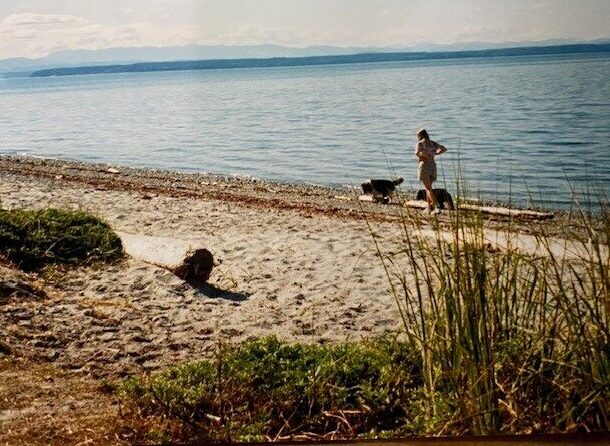
*Photo of my daughter Maureen and me was taken in 1997 on Lantzville Beach…I believe the small round looking island in the distance is Maude Island. The other photo is a stranger walking her dogs 1997, same beach. Best swimming beach ever!!!!

Facebooktwittermail